Dear Neighbor,
Several owners asked whether reducing winter pool hours would save money. Our last message focused on the savings from a full five‑month shutdown, which is the maximum possible savings. Reducing hours saves even less — and the FirstService survey never explains what “reduced hours” even means. Without that information, owners can’t give meaningful feedback. Here is a simple breakdown based on actual invoices and the proposal discussed at the January 8th meeting. |
1. What “reduced hours” actually means |
At that January 8th meeting, Vice President Ketki Shah proposed changing winter hours from 6am–10pm to 7am–4pm from November 1st through March 31st. That means the pool would be covered 8 more hours per day. But chemicals, service, and circulation are still required during the hours the pool is open, so the savings are small. |
2. Water savings (evaporation) — very small |
With full closure, evaporation savings are about 252 gallons/day. With reduced hours, it drops to about 50 gallons/day. Using the same EBMUD rates from our last email, the total savings for the five winter months would be: - ~$393 total, or
- ~7¢ per unit/month over a year.
|
3. Gas savings — the largest category, but still small |
Using PG&E’s actual winter rates and standard engineering calculations for our pool and heater: - ~1,473 therms would be saved over the 151 winter days.
- The total savings is : ~$4,392.
- This is equivalent to ~75¢ per unit/month over a year.
- That is about 0.08% of the current $980/month dues for a 2‑bedroom unit.
|
4. Heater lifespan savings — pennies |
Our current high efficiency gas heater cost $16,241 and is expected to have a 3‑year lifespan (1,095 days). Reducing the heat load in winter could extend its life by about 56 days, or 18.7 days per year. That’s about: - ~$277/year, or
- ~5¢ per unit/month over a year.
|
5. Total realistic savings from reduced hours |
Adding everything together: - This is ~$5,062/year total savings.
- Which is equivalent to ~87¢ per unit/month over a year.
- That is about .09% of current dues for a 2-bedroom unit. Less than one‑tenth of one percent.
This is the real scale of the savings — not the 20–25% implied by the survey. |
6. Maintenance matters more than reduced hours |
If the pool heater were properly maintained, its lifespan could be increased without reducing hours. Remember: our domestic hot water boilers failed halfway through their expected life because, according to the manufacturer: “The failed heat exchanger was garbage and hadn’t been maintained properly.” Those premature failures cost the HOA $110,000 in 2023 and 2024. Timely maintenance, not reduced hours, is where the real savings are. |
7. Utility costs in context |
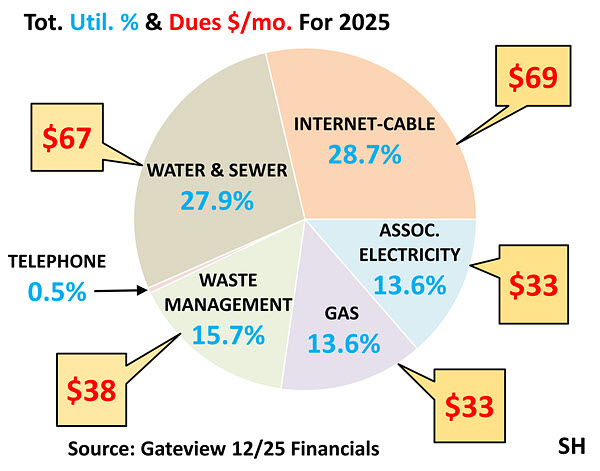
Here is the average monthly utility cost breakdown for 2025: |
|
In this pie chart, a 0.09% slice would be invisible. |
As you can see, pool‑related savings from reduced hours is a tiny fraction of your monthly assessment, even less than the telephone bill. |
8. Agenda items dropped without explanation |
Steven submitted two agenda items for this month's regularly scheduled open session — both directly related to the pool: - Installing a gas meter on the pool heater so we can measure real gas usage.
- A ballot question asking owners whether they support a winter shutdown.
Neither item was included, without explanation. Owners deserve transparency, not political gatekeeping for regular meetings. |
9. Where real savings come from |
We believe meaningful savings come from: - Genuine competitive bidding (not FirstService preferred vendor's one-sided quotes).
- Fixing water pressure and hot water delivery issues.
- Stopping unnecessary and improperly reserve‑funded upgrades.
- Transparent surveys and communications.
- Holding vendors accountable for better performance.
- Timely maintenance of infrastructure.
Not from reducing pool hours for savings measured in pennies. |
As always, you can reach out to us if you have concerns about your property or how it is being operated. Thank you! Sincerely, Karim
Steven |
|
|
|